Sarıcakaya Plant Guide
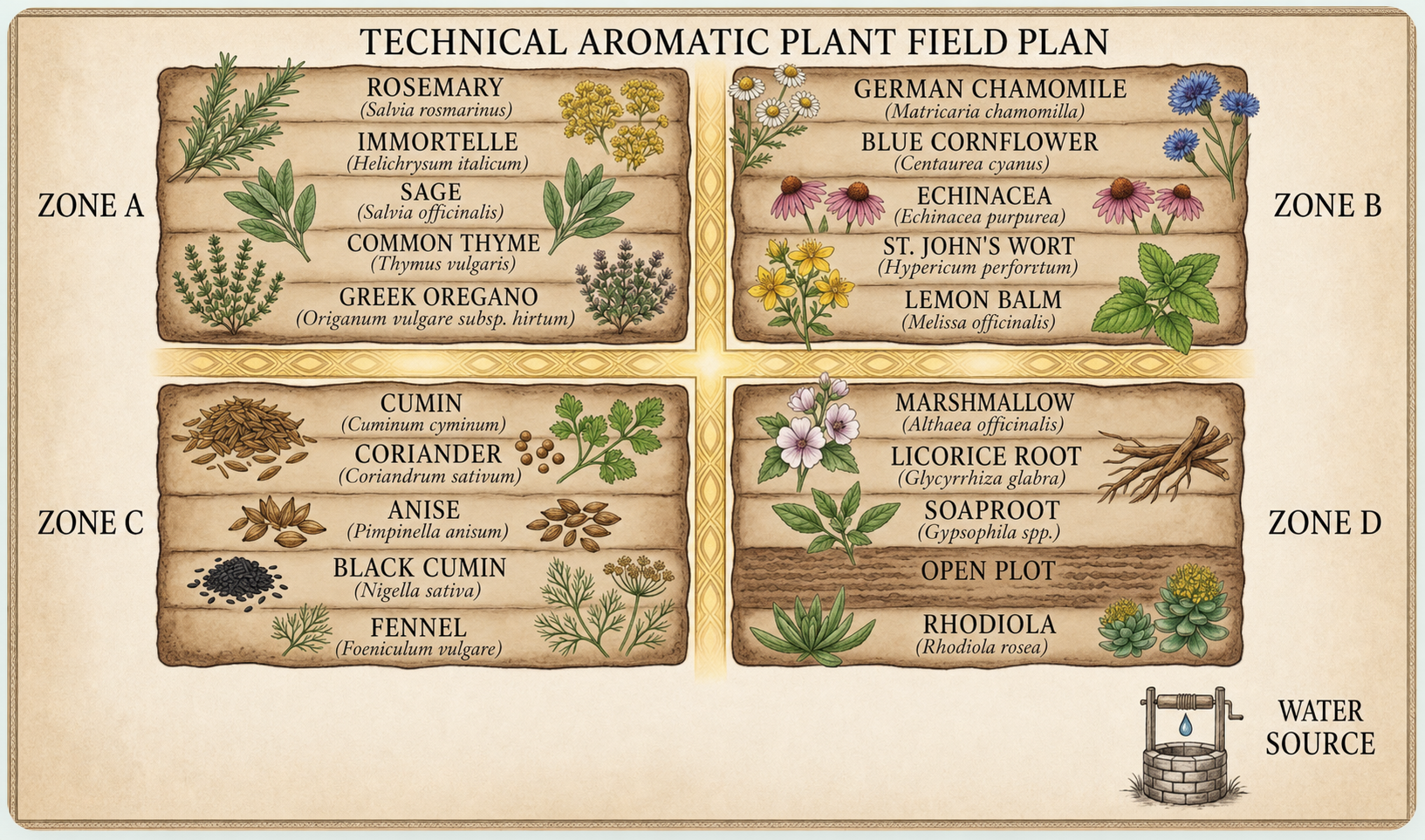
20 decares, 20 species, four irrigation zones. This guide answers one practical question: how did each crop perform in this microclimate, soil and water regime? Every plant card combines technical guidance with field-level observations.
Sage, Common Thyme, Greek Oregano, Rosemary, Immortelle
The driest, best-drained area. Excess irrigation reduces quality. Place rosemary and immortelle at the sheltered end.
Lemon Balm, German Chamomile, Echinacea, Blue Cornflower, St. John’s Wort
Crops needing more regular irrigation and flower-performance monitoring. Lemon balm is the most sensitive member of this zone.
Fennel, Anise, Cumin, Coriander, Black Cumin
A fine seedbed, emergence monitoring and weed control are critical. Keep tall fennel at the edge.
Marshmallow, Licorice, Rhodiola, Soaproot, Hawthorn
The patience block. Choose the site correctly from the outset. Rhodiola is a stand-alone research trial; hawthorn belongs on the perimeter.
These three share the same irrigation regime and soil requirements, making them natural neighbours.
Both carry winter risk; evaluate them together at the sheltered end of Zone A.
They have similar water needs and attract pollinators. Place lemon balm on the moister edge of this group.
They share a similar harvest cycle. Keep tall fennel at the outer edge.
A long-term root-crop trial requiring two to three years of observation.
Its requirements are completely different; reserve the coolest, moistest corner.
Use it as a windbreak and landscape element along the perimeter, not in the centre of the field.
| Plant | Planting Method | Timing | Note |
|---|---|---|---|
Hawthorn(Crataegus spp.)
|
Bare-root seedling | November – March | Plant during winter dormancy, after leaf fall. |
German Chamomile (Medicinal Chamomile)(Chamomilla recutita)
|
Direct sowing | September–October or March–April | Surface-sow the very fine seed; avoid summer heat. |
Coriander(Coriandrum sativum)
|
Direct sowing | Second week of October or March–April | Benefits from cool weather; delayed spring sowing can reduce yield. |
Blue Cornflower(Centaurea cyanus)
|
Direct sowing | September–October or March–April | Use controlled spring sowing on commercial plots. |
Black Cumin(Nigella sativa)
|
Direct sowing | March to mid-April | In Eskişehir, test autumn sowing only on a small pilot plot. |
Anise(Pimpinella anisum)
|
Direct sowing | March–April | Sow as soon as the soil is workable; delay increases maturity risk. |
Fennel(Foeniculum vulgare)
|
Direct sowing | April–May | Direct-sow when the soil reaches 6–8°C. |
Sage(Salvia officinalis)
|
Transplanting | Late May – mid-June | Plant after the last frost. |
Common Thyme (Garden Thyme)(Thymus vulgaris)
|
Transplanting | Late May – mid-June | Transplants are preferred for uniform establishment. |
Greek Oregano (Izmir Oregano)(Origanum vulgare subsp. hirtum)
|
Transplanting | Late May – mid-June | After late frost |
|
Lemon Balm(Melissa officinalis)
Tender species
|
Transplanting | Late May – mid-June | Plant only after the risk of cold damage has passed. |
Cumin(Cuminum cyminum)
|
Direct sowing | February – 20/25 March | Sow early when soil is workable; do not delay until May–June. |
St. John’s Wort(Hypericum perforatum)
|
Transplanting or seed | Late May – mid-June | Transplant after the last frost. |
Echinacea(Echinacea purpurea)
|
Transplanting | Late May – mid-June | After late frost |
Marshmallow(Althaea officinalis)
|
Transplanting | Late May – mid-June | Plant once the soil has warmed. |
Licorice Root(Glycyrrhiza glabra)
|
Root/seedling planting | Late May – mid-June | Safer after the last frost. |
|
Rhodiola(Rhodiola rosea)
Tender species
|
Transplanting | Late May – mid-June | Special preparation required |
Soaproot (Gypsophila)(Gypsophila spp.)
|
Transplanting | Late May – mid-June | After late frost |
|
Rosemary(Rosmarinus officinalis / Salvia rosmarinus)
Tender species
|
Rooted cutting | Late May – mid-June | Plant rooted cuttings in spring after the last frost. |
|
Immortelle(Helichrysum italicum)
Tender species
|
Transplanting | Late May – mid-June | Plant strictly after the last frost. |
First 30 Days
Mid-Summer
Harvest and Winter Survival
Class A — Keep and Expand
Well adapted to Sarıcakaya, easy to manage and tolerant of stress. A candidate for expansion in year two.
Class B — Trial for One More Year
Shows potential, but the result may reflect site, irrigation or seasonal effects. Retest under adjusted conditions in year two.
Class C — Remove
Poor adaptation, uneconomic performance or persistent management problems. Replace it with a new trial or expand a Class A crop.
Drought-Tolerant Aromatics
Use raised rows, drip irrigation and limited water for sage, thyme, Greek oregano, rosemary and immortelle.
Moderate-Water Flower Crops
Use lightly raised rows, drip irrigation and moderate water for lemon balm, German chamomile, echinacea and St. John’s wort.
Seed Crops
Use a level, fine seedbed and rigorous early weed control for cumin, coriander, anise, black cumin and fennel.
Root Crops
Deep cultivation, raised rows and patience are essential. Marshmallow, licorice and soaproot require multi-year observation.
Rhodiola
A separate trial requiring its own cool microclimate, prepared bed and management regime.
Hawthorn
Plant a limited row along the perimeter as a windbreak and landscape element, not in the middle of the field.
Irrigation Infrastructure
Four zones require four irrigation regimes. Zone-level valves are essential; Zone A and Zone B must not share one watering schedule.
Soil Analysis
Before planting, test pH, organic matter, macro- and micronutrients, texture and salinity. Take a separate sample from each zone.
Weed Management
Weed control is decisive in Zone C. Consider a stale seedbed: prepare the soil, wait two weeks, remove emerged weeds, then sow.
Wind and Microclimate
Northern winds can be severe. Use hawthorn on the perimeter as a windbreak and keep Rhodiola and immortelle out of exposed positions.
Pest and Disease Monitoring
Monitor cumin for Fusarium wilt, chamomile for aphids, and echinacea and lemon balm for root rot. Walk and photograph the plot weekly.
Record-Keeping Discipline
Use block labels, GPS coordinates and dated photographs. Without disciplined records, the trial loses decision value.